Senior Futures Trader

Jens-Werner
Winkler

Team Lead · Trading Technology Specialist · Zug, Switzerland

German national with 13+ years of professional trading experience. M.Sc. in Business Information Technology. Specializing in ES/NQ Futures, leading a 5-member proprietary trading team, and developing custom trading systems.

50K+
Trades
13+
Years
€2.5M
Equity
+132%
Year Delta
Jens-Werner Winkler
Status: Available
Zug, CH
Open to Opportunities
Looking for New Challenges
Experienced senior trader seeking high-performance trading environments. Open to full-time, contract, and consulting roles.
🎯

Senior Trader Positions

Prop trading, institutional, or senior trading roles leveraging 13+ years of experience and a proven track record in ES/NQ futures.

Energy Trader 24/7

Specialized in high-frequency energy markets with round-the-clock availability. Experience with global energy futures and commodities.

💼

Hedge Funds

Systematic trading roles at hedge funds. Strong background in quantitative strategies and risk management.

👥

Team Management

Head trader, mentor, or training roles. Proven leader with experience managing 5-member trading teams.

📈 Futures
💹 CFDs
📊 Stocks
⚡ Energy
🤖 Algo Trading
Core Competencies
Expertise
📈

ES/NQ Futures Trading

Specialized in intraday scalping using volume profile, orderflow, and delta analysis. Consistent performance with 72.3% win rate over 12,000+ trades.

👥

Team Leadership

Leading 5-member proprietary trading team. Mentoring junior traders in footprint trading and risk management strategies.

💻

Trading Software

Developed custom trading tools for orderflow analysis and automated risk management using Python, C#, and NinjaTrader 8.

🎓

Quantitative Analysis

M.Sc. in Business Information Technology. Expertise in statistical modeling, backtesting, and machine learning integration.

Career Path
Professional Experience
2017 — Present

Proprietary Trading Team Lead

Independent · Zug, Switzerland

Leading a 5-member trading team focused on ES/NQ Futures. Developed proprietary trading software and implemented quantitative strategies. Grew equity from €100K to €2.5M.

2014 — 2017

Futures Trader & Instructor

Axia Futures · London, UK

Profitable proprietary trading and training junior traders in footprint trading and advanced orderflow techniques.

2012 — 2014

Junior Futures Trader

Diamond Trading · Paris, France

Active futures trading in an international institutional environment with specialization in volume analytics and orderflow strategies.

Performance
Last 4 Year Track Record
ES & NQ Futures with a systematic approach based on Volume Profile & Order Flow Analysis.
€100K
Starting Capital
€2.5M
Current Equity
+2,400%
Total Return
+132%
Year Delta
12,000
Total Trades
72.3%
Win Rate
1.50
Sharpe Ratio
1.85
Profit Factor

ES & NQ Trading System

Instruments

ES & NQ E-mini Futures

1-minute timeframe

Methodology

Move-Based Volume Profile

Dynamic POC & Order Flow

Trading Style

Intraday Scalping

Max 3 trades/day

Optimal Times

9:30–11:00 AM ET

2:00–3:30 PM ET

5 Core Trading Setups

01
75.3% Win Rate

POC Bounce

Dynamic Point of Control bounce with volume confirmation and absorption patterns.
02
65.7% Win Rate

Big Trade Reversal

Counter-trend entries following exhaustion with 600+ contract volume spikes.
03
70.4% Win Rate

Absorption Breakout

High-volume compression zones breaking out with delta confirmation.
04
61.0% Win Rate

Double Top/Bottom

Price testing same level twice with volume and delta divergence.
05
69.0% Win Rate

Trend Continuation

Pullback entries in established trends with decreasing volume.

Volume Analysis for NQ

CategoryThreshold
Average Volume~200 contracts/bar
Big Trade>600 contracts
Absorption>400 contracts
Huge Trade>1,000 contracts

Preferred Trading Software

NinjaTrader

with MzPack

ATAS

Advanced Platform

Jigsaw Trading

DOM & Tape

Sierra Chart

Professional

Trading Technologies

TT Platform

Bookmap

Heatmap

Risk Management Framework

🎯

Max 3 Trades/Day

Stop After 2 Losses

📊

2% Risk Per Trade

🚫

2% Max Daily Loss

Position Management

T1 (50%)

First resistance / 1R

T2 (25%)

Major level / 2R

Runner (25%)

Trail with 5pt stop

"Success in trading comes from systematic execution, disciplined risk management, and the ability to read institutional order flow. My approach combines technical precision with volume analysis to identify high-probability setups in ES & NQ."

Example Trade Setups

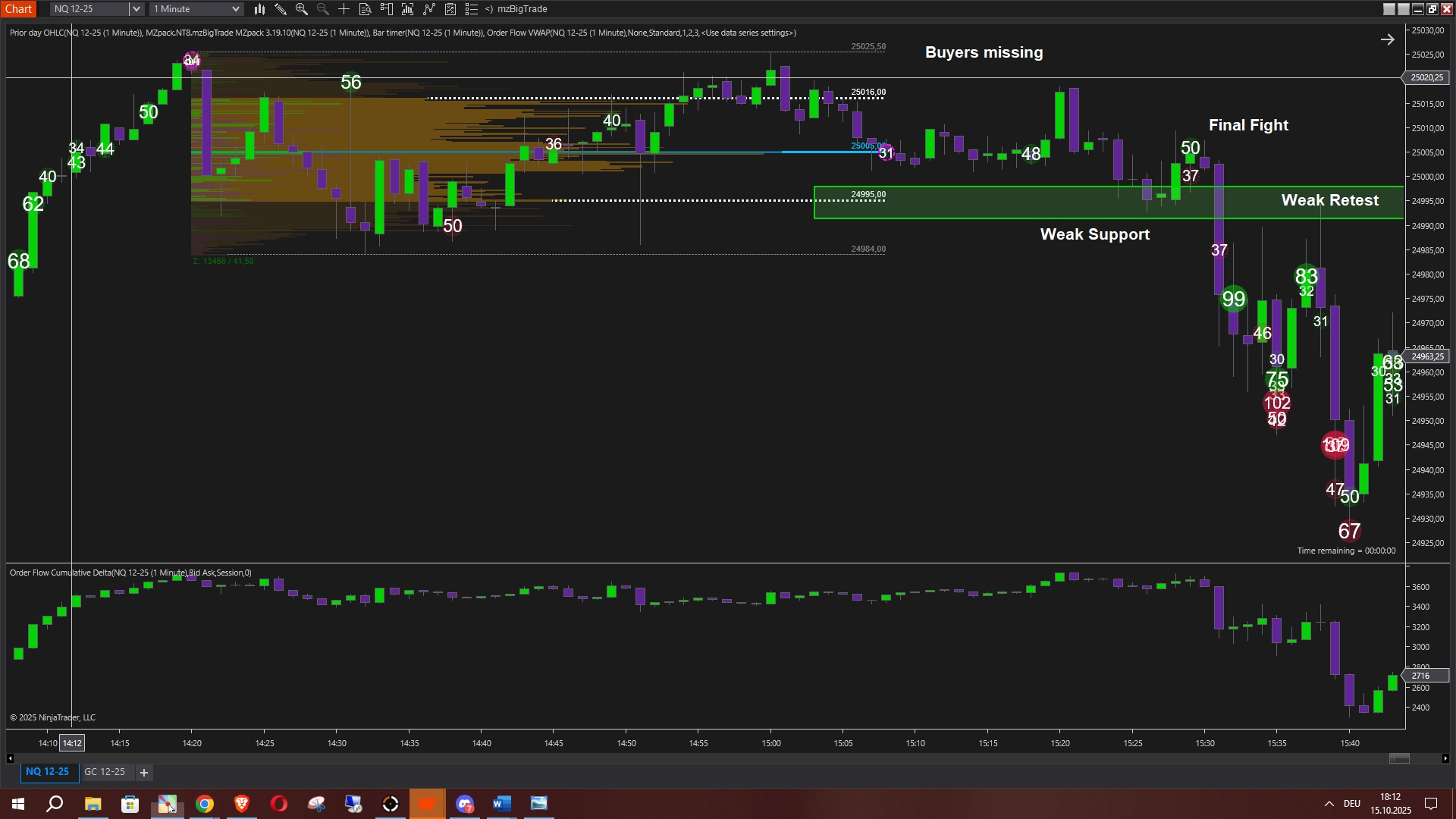
Volume Profile Analysis

Support/Resistance Analysis

Volume profile showing buyers missing at key levels, final fight at resistance, and weak support retest with delta confirmation.

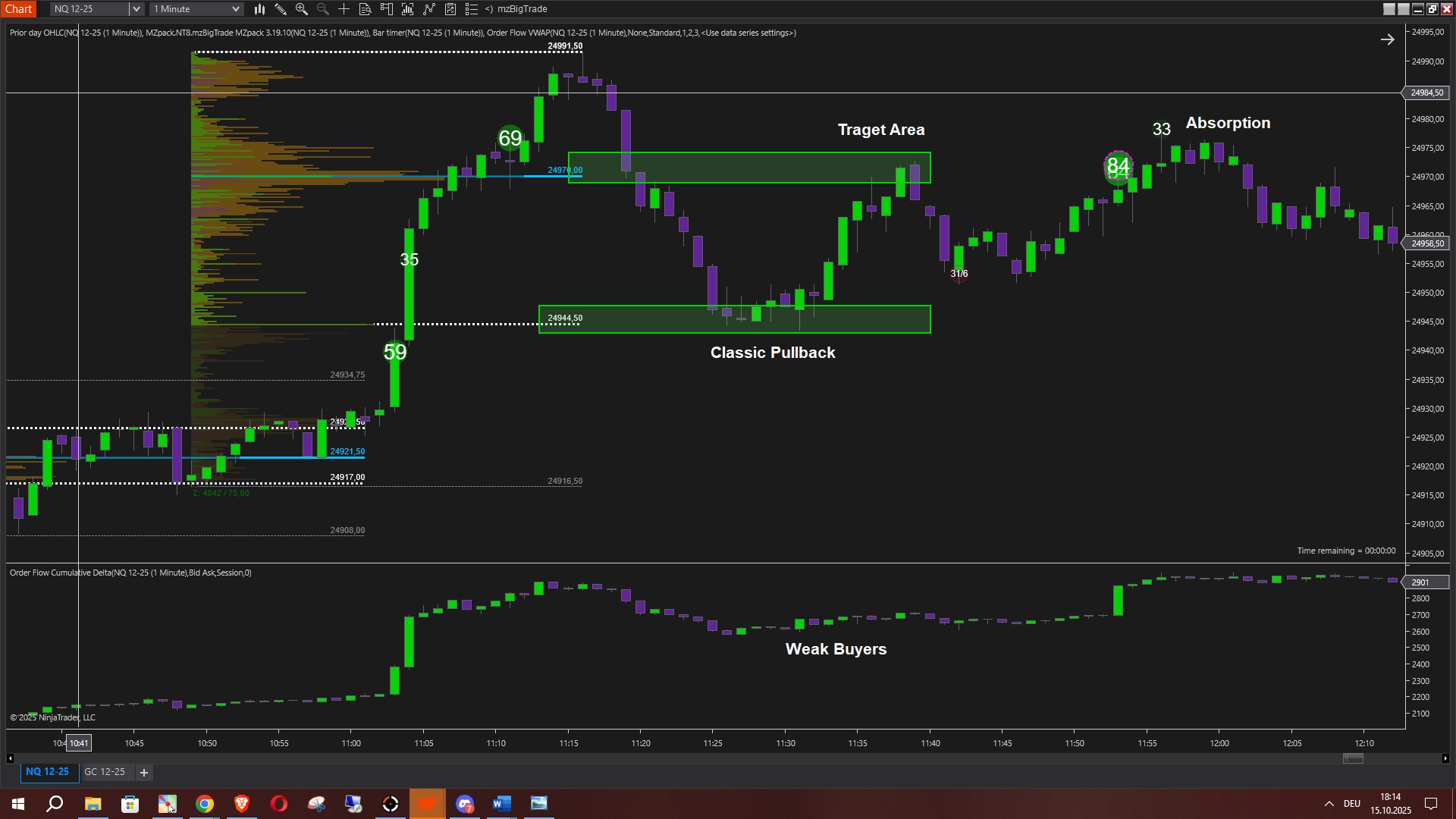
Classic Pullback Setup

Classic Pullback Entry

Strong uptrend with pullback to support, clear target area defined by volume profile, and absorption pattern confirming buyer strength.

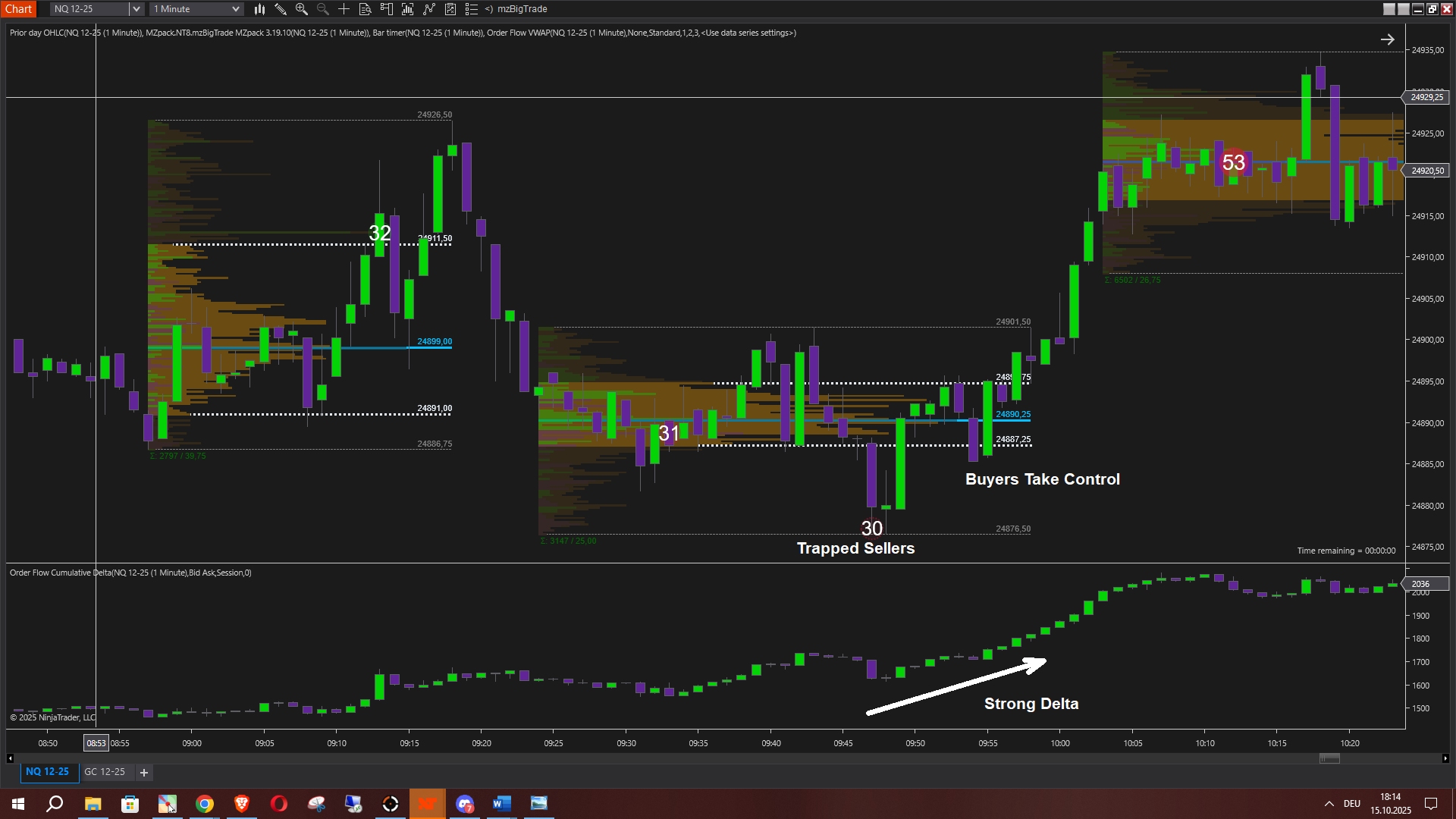
Orderflow Reversal

Delta Divergence Long

Trapped sellers at support, buyers take control with strong positive delta shift, volume profile confirms institutional accumulation.

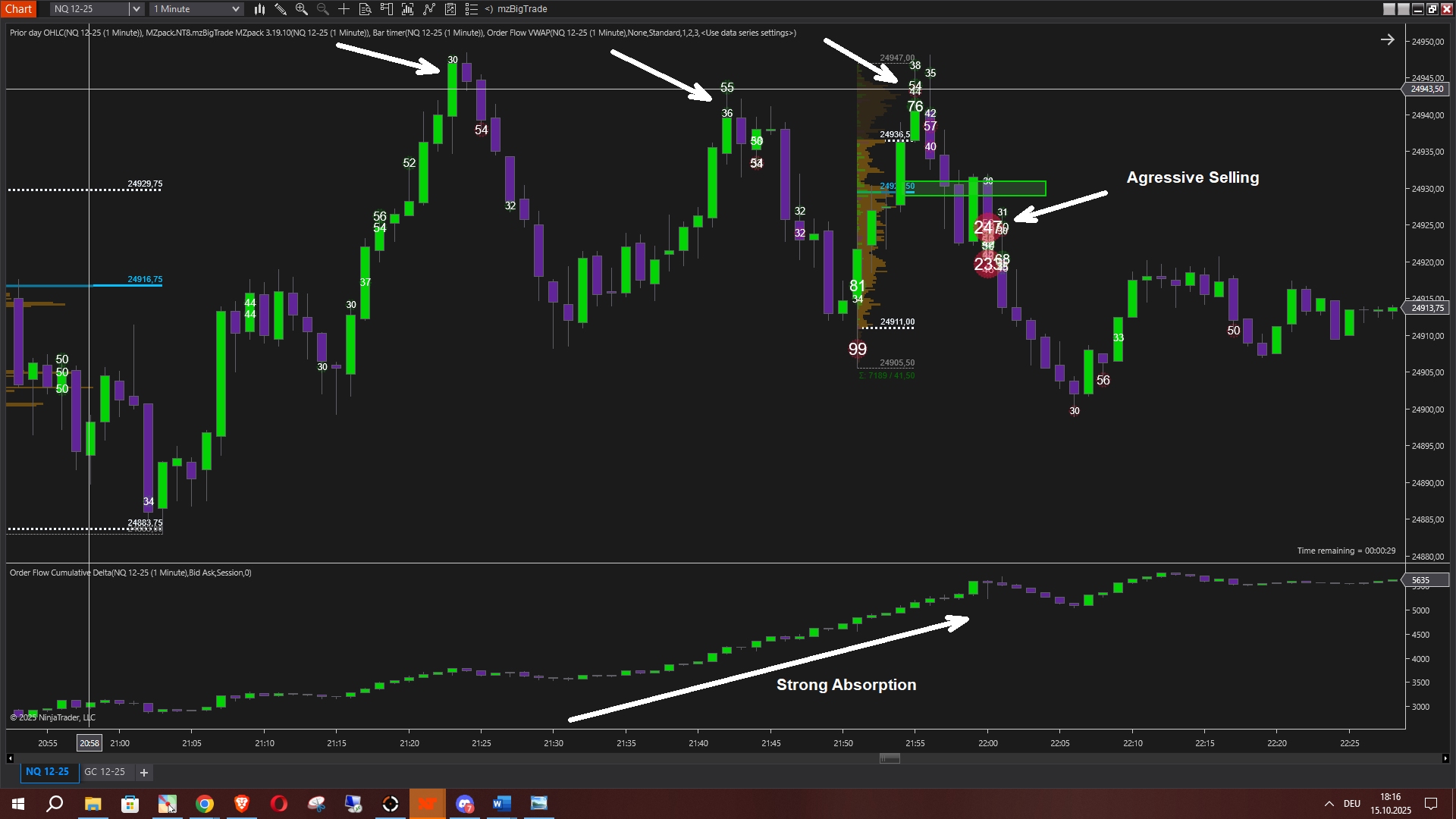
Absorption Pattern

Absorption Breakout

Multiple aggressive selling attempts absorbed at resistance, strong delta showing buyers defending level, breakout confirmation.

* Chart examples illustrate setup principles. Actual trade screenshots available upon request.

Methodology
Trading Strategy

The Big Picture

Markets work like auctions — price moves between two states: Balance (price bounces around fair value, ~70% of the time) and Imbalance (one side takes control, pushing price to find new fair value). Most traders lose because they trade breakouts without checking which state the market is in. The solution: only trade when three things align — Market State + Location + Aggression.

Trend Model SETUP 1

Ride the wave — follow strong moves in the direction of the trend
Best timing: New York session (NASDAQ, ES). Avoid London open (too many fake breakouts).
Step 1

Confirm the Market is Trending

Look for clear momentum away from the previous range. If price is just bouncing up and down — skip.

Step 2

Find Your Entry Level

  • Take the strong move that broke structure
  • Apply Volume Profile to that move
  • Find LVNs (Low Volume Nodes) — gaps where price moved fast
  • Set alerts at these LVNs (don't enter blindly)
Step 3

Wait for Confirmation

When price pulls back to the LVN, check for aggression: big BUY prints for longs, big SELL prints for shorts. No aggression = no trade.

Step 4

Manage Your Risk

  • Stop Loss: just beyond the aggressive print + 1-2 tick buffer
  • Position Size: risk only 0.25%–0.5% per trade
  • Break-even: move stop to BE if CVD shows strong pressure
Step 5

Take Profit

Target the POC from the previous balance. Close full position at POC — 70% of the time, price reverses from balance areas.

Mean Reversion Model SETUP 2

Snap back — trade the snap-back when breakouts fail
Best timing: London session. Compressed/summer market conditions.
Step 1

Confirm Market is in Balance

Use previous day's profile as reference. Watch for price trying to break out but failing.

Step 2

Wait for the Reclaim

Don't take the first move back. Wait for a clear reclaim back inside balance, then a pullback after the reclaim.

Step 3

Find Your Entry

Apply Volume Profile on the reclaim leg. Mark LVNs. On pullback into LVN, check order flow for aggression.

Step 4

Manage Your Risk

  • Stop Loss: just beyond aggressive print + 1-2 tick buffer
  • Position Size: 0.25%–0.5% per trade
  • If wrong, you're wrong immediately — never widen stops
Step 5

Take Profit

Target: Balance POC (center of value). Exit full position at POC.

✅ Advantages

Clear Rules

No guessing, follow 3 steps

All Conditions

One setup for trends, one for ranges

Small Risk

Tight stops keep losses manageable

Many Opportunities

Lots of trades to build consistency

Prevents Overtrading

If conditions aren't right, don't trade

Good Risk/Reward

Typically 1:2.5 to 1:5

⚠️ Things to Know

Small Losses Are Normal

You'll have losing streaks

Full Attention Required

Watch during trading sessions

Choppy Days Happen

Some days just don't work

Mental Strength

Managing positions requires discipline

Trade Checklist

Market state clear (balanced or imbalanced)?
At key level (LVN from Volume Profile)?
Aggression confirmed (big prints in your direction)?
Stop loss placed?
Position size calculated (0.25–0.5%)?

If even ONE is missing → Don't trade

Key Terms

Balance
Price rotating in a range, buyers and sellers equal
Imbalance
One side dominating, pushing price directionally
POC
Point of Control — price level with most trading activity
LVN
Low Volume Node — price levels where volume was very low
Aggression
Large orders showing strong buying or selling pressure
CVD
Cumulative Volume Delta — tracks buyer/seller control

If the market isn't giving you clear conditions across all three filters — State + Location + Aggression — stay flat. Patience is profit.

Current Work
Neural Networks for Futures Trading
Exploring reinforcement learning and deep learning architectures to build adaptive, self-improving trading agents for NQ/ES futures markets.
Actively Researching

Building Intelligent Trading Agents

Currently developing neural network-based systems that learn optimal trading strategies directly from market data. Instead of hand-coding rules, these agents observe price action, orderflow, and volume profiles — then learn through trial and error which actions maximize risk-adjusted returns. The goal is to combine the systematic precision of algorithmic execution with the adaptive intelligence of deep reinforcement learning.

Reinforcement Learning Policy Gradient Methods Actor-Critic Models NQ/ES Futures PyTorch Gymnasium Envs Walk-Forward Validation

How It Works: The RL Trading Pipeline

A reinforcement learning agent interacts with a market environment in a feedback loop — observing state, taking actions, and learning from rewards to improve its policy over time.

📊
Market Data
OHLCV + Orderflow
🧠
Neural Network
Policy / Value Net
Action
Buy / Sell / Hold
💰
Reward
Risk-Adj. PnL
🔄
Learn & Adapt
Update Weights

Key Algorithms in Futures Trading

Research and practice have identified specific architectures that are particularly effective for financial markets. Each approach has distinct strengths depending on market conditions and trading style.

Policy Gradient

PPO

Proximal Policy Optimization

Considered the most stable algorithm for volatile markets. PPO constrains policy updates to prevent catastrophic performance drops — critical when trading fast-moving NQ futures. Widely used in research on Chinese rebar futures and US equity indices, it excels at learning robust strategies that don't collapse during regime changes.

High stability Volatile markets Clipped updates On-policy
Value-Based

DQN

Deep Q-Network

A value-based approach that learns to estimate the expected reward of each possible action. DQN serves as a strong baseline in most trading research and delivers solid results for trend prediction. Its experience replay mechanism allows efficient learning from historical data, making it well-suited for backtesting-heavy development workflows.

Strong baseline Trend prediction Experience replay Off-policy
Actor-Critic

DDPG / TD3

Deep Deterministic Policy Gradient / Twin Delayed

Actor-Critic models that excel at continuous action spaces — perfect for precisely scaling position sizes based on market volatility. Rather than choosing between discrete "buy/sell" actions, DDPG can output exact position fractions, enabling sophisticated risk management. TD3 adds twin critics and delayed updates for further stability.

Continuous actions Position scaling Twin critics Off-policy
Algorithm Type Action Space Stability Best For
PPO
Policy Gradient Discrete & Continuous
Very High
Volatile markets, regime changes, robust policies
DQN
Value-Based Discrete only
Moderate
Trend prediction, research baselines, rapid prototyping
DDPG/TD3
Actor-Critic Continuous
High (TD3)
Position sizing, volatility-adapted scaling, fine-grained control

Live Performance: Neural Network Trader

Production results from the neural network trading system running on NQ futures. Averaging ~1,000 trades per day with consistent daily profitability across 18 out of 20 trading days per month.

Live System NQ Futures · Fully Automated
$4,500
Daily Profit
~1,000
Trades / Day
$1,000
Max Drawdown
18/20
Profit Days
~$90K
Monthly Est.
90%
Win Days Rate
Research in progress: Currently training PPO and TD3 agents on NQ futures tick data with custom Gymnasium environments. The reward function incorporates Sharpe ratio, maximum drawdown penalty, and transaction cost awareness. Walk-forward validation ensures results generalize to unseen market regimes.
Hardware Acceleration

Currently Working on FPGA HFT Trading

Ultra-Low Latency · Nanosecond Execution · Hardware-Level Speed

Latency Requirements by Industry
Web
🌐
~150ms
Real-Time Apps
🎮
<50ms
Automotive
🚗
1–10ms
Trading
μs → ns
<100ns trigger
<350ns complex
SLOWER ────────────────────── FASTER
Ultra-Low Latency

From Microseconds to Nanoseconds

With FPGA hardware acceleration, achieve latency below 100ns for trigger-based strategies and below 350ns with book building and more complex strategies. Direct market data parsing and order generation happen entirely in hardware — no operating system, no kernel, no jitter.

<100ns
Trigger Strategies
<350ns
Complex + Book
C++ Programmability

Time is Money — Skip Years of Development

Create your trading algorithm in C/C++ and convert it directly into FPGA logic. No hardware description language expertise needed — go from strategy code to nanosecond execution in weeks, not years. Leveraging tools like Magmio for High-Level Synthesis, the barrier to FPGA trading has never been lower.

C/C++ to FPGA High-Level Synthesis No FPGA Knowledge Weeks to Deploy Magmio Platform
Hardware edge: FPGA-based trading eliminates the software stack entirely. Market data is parsed at wire speed, strategy logic executes in combinational hardware, and orders are generated in a single clock cycle. This is the competitive frontier where microseconds are too slow and nanoseconds define the winners.

Research
Research & Strategy Playbooks
Walk-forward validated system analysis with anti-overfit methodology, plus comprehensive strategy rulebooks covering auction theory, orderflow, and scalping frameworks.
Live Trade Analysis

NQ Trade Analysis Report

Session analysis from 2026-03-13 covering NQ Futures. Signal performance breakdown, equity curves, drawdown analysis, and directional edge detection.

NQ Futures Multi-Signal Mar 2026
Strategy Optimization

Sweep Robust Optimization (Anti-Overfit)

696 trades with walk-forward 60/40 split and 5-fold CV. Best config: SL15 LONG with 78.9% win rate, Robust Score 3.34, OOS Sharpe 4.99.

Anti-Overfit Walk-Forward 5-Fold CV
System Analysis

2-3 Contract Session Trading System

12,452 SWEEP + 1,366 BIGTRADE signals across 10 trading days. Multi-contract analysis with EU/US session breakdown and walk-forward validation.

12K+ Trades SWEEP + BIGTRADE $5/tick
Session Deep-Dive

SWEEP EU Detailed Day-by-Day

1,493 EU session trades across 9 days. 4 models (Long/Short × 2C/3C) with equity curves showing up to $18,229 profit. Hourly PnL breakdown in CET.

EU Session 4 Models Day-by-Day
Strategy Playbook

Fabervaale — Auction Market Playbook

Complete auction market theory rulebook. Balance vs imbalance states, market profile interpretation, and systematic entry/exit frameworks for institutional-grade execution.

Auction Theory Market Profile Playbook
Strategy Playbook

Orderflow Rules Book

Comprehensive orderflow analysis methodology. Footprint reading, delta interpretation, absorption detection, and aggressive order identification for NQ/ES futures scalping.

Order Flow Delta Analysis Footprint
Strategy Blueprint

ORB × Order Flow Strategy Blueprint

Opening Range Breakout strategy enhanced with orderflow confirmation. Session timing, range identification, and multi-signal confluence framework for high-probability entries.

ORB Strategy Session Timing Blueprint
Strategy Playbook

Deep Chart Scalper — Order Flow Playbook

Advanced scalping methodology using deep chart analysis. Multi-timeframe orderflow reading, precision entries with tight risk, and systematic approach to NQ futures micro-structure.

Deep Scalping Multi-TF Playbook
Live Analysis
ES Futures — Live ML Signals
Real-time market analysis powered by 7 XGBoost models, order flow data, and technical indicators. Auto-refreshes every 15 minutes.
Live ES 06-26
Updated: — 15:00
Education
Trading Education & Analysis
Video tutorials covering trading strategies, market analysis, and educational content.

Volume Profile Trading Strategy

Deep dive into move-based volume profile analysis and POC bounce setups.

Orderflow & Footprint Analysis

Understanding institutional order flow and delta divergence signals.

ES/NQ Market Structure

Live market analysis showing key support/resistance levels and trade setups.

Risk Management & Position Sizing

Essential risk management techniques for consistent profitability.

Tools & Software
Downloads
Battle-tested trading software and tools actively used in live trading. NinjaTrader 8 and Python ecosystem.
🔔

Discord Messenger

Automated alert system sending trading signals and chart screenshots to Discord. Real-time notifications for trade setups and executions.

Discord APIC# + WebhookScreenshots
📥 Download
📈

Fair Value Gap Trading System

Python-based FVG trading system with charting capabilities. Alpha version with Fair Value Gap detection and visualization.

Python 3.xChart AnalysisFVG Detection
📥 Download
🧪

Simple Backtest HTML Based

HTML-based backtesting tool for FVG strategies. Easy-to-use interface for analyzing historical performance with visual results.

HTML/JSVisual AnalysisFast Testing
📥 Download
🤖

Fully Working Python Algo with Backtest

Complete automated trading system for NinjaTrader via TCP connection. Includes FVG detection, backtesting engine, and live execution.

Python 3.xTCP ConnectionFull System
📥 Download
🛠️

Mix of Trading Tools

Collection of various trading utilities and helper tools. Includes indicators, scripts, and analysis tools used in daily trading.

Multiple ToolsUtilitiesIndicators
📥 Download
🧠

NinjaTrader 8 MCP Server New

A Model Context Protocol (MCP) server that bridges NinjaTrader 8 with AI assistants like Claude. Exposes live market data, account positions, order management, and historical OHLCV bars through the standardized MCP tool interface. Built on a TCP socket architecture with JSON message framing — the NinjaTrader C# indicator streams tick data, orderflow signals, and execution confirmations to the MCP server layer, which translates them into tool calls that any MCP-compatible AI client can consume. Enables natural-language trade analysis, AI-powered position monitoring, and conversational strategy development directly against your live NinjaTrader session.

MCP Protocol NinjaTrader 8 C# Indicator Python Server TCP Socket JSON-RPC Claude / AI
📥 Download Server
📊

Range Breakout Trader New

Fully automated NinjaTrader 8 strategy that identifies intraday consolidation ranges and trades the breakout with aggressive risk-to-reward targeting. The system operates with a deliberate low win rate of 30–45%, offset by consistently large winners at 3:1 to 4:1 reward-to-risk ratios — a proven approach in trending NQ/ES sessions. Backtested on a $100K account with approximately $3,500 annual net profit and controlled maximum drawdown, making it suitable as a steady compounding engine alongside discretionary trading. Includes configurable range detection window, session filters, and breakeven-to-trail logic.

30–45%
Win Rate
3:1 – 4:1
Risk : Reward
~$3,500
Annual Profit
$100K
Account Size
NinjaTrader 8 Automated Strategy Range Detection Breakout Logic Low WR / High RR
📥 Download Strategy
Note: All software is provided for professional use. Requires NinjaTrader 8+ and Python 3.8+. For support or custom development inquiries, please contact me.
Get in Touch
Contact
Interested in collaboration, have questions, or want to discuss opportunities?
🇩🇪
Nationality
German
🇨🇭
Location
Zug, Switzerland
🎓
Education
M.Sc. Business IT
📧
Email
💬
Discord
snej8809